


ADSR as AMP envelope – is shaping the sound we are hearing.
ADSR stand for Attack, Decay, Sustain and Release – it is not the most complex sort of envelopes but that’s what we have on a lot of synths. Software synth gives sometimes more complex envelopes.
ADSR is the « classic » envelope model you find the ADSR on a lot of hardware synth.
Attack: Time it takes for the sound to reach its maximum volume after the note is triggered on a keyboard.
Decay: How quickly the sound’s volume drops.
Sustain: This is the volume of the sound when a key is held
Release: Time for the sound to decay to zero after the key is released.
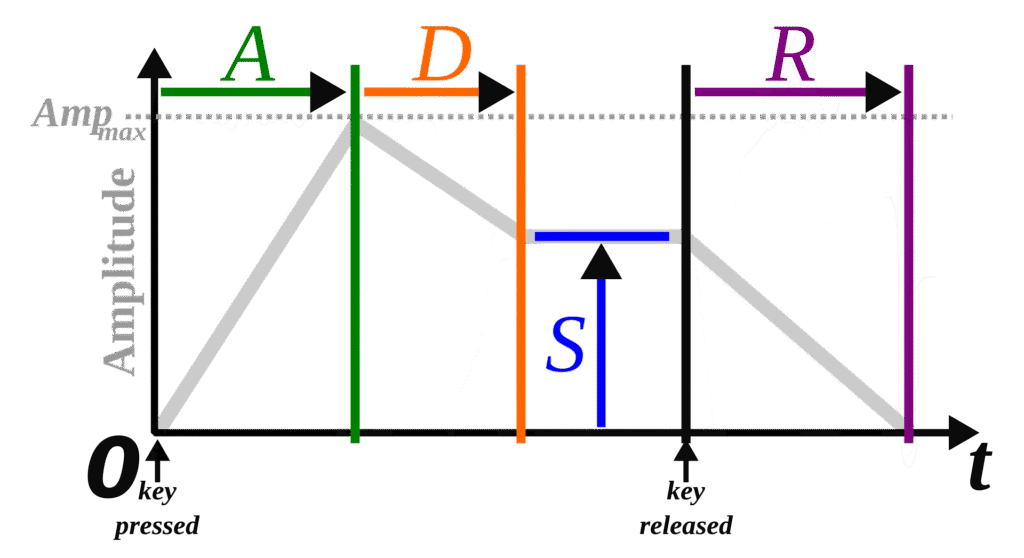
Again i will make the understanding of it as simple as i can.
If we compare a Bass guitar and a Cello on an ADSR point view : a Bass guitar will have more attack than a Cello if we consider the musician playing the Cello soft and sustained with the bow progressively, constant and slow. When the musician slaps their bass guitar we probably had something with more attack and less sustain. Cello like strings take benefit of its timbre when played sustained – it’s beautiful. Then the bass by nature sound tight and are less sustain giving this warmth and dynamic for our bass line (funky or not)
That’s how I would describe ADSR we mimic that so we must have few things in mind as : How does the sound take life ? How long the sound is sustained for ? Is it something percussive ? Is it something soft ? Is it something with a high amplitude at the beginning then drops fast in amplitude but still sustains long at a certain volume? All sorts of questions to ask yourself when you hear a sounds source. There is no generic answer because it’s specific to each sound you hear.
That’s one of the behaviors of a sound who helps us to classify it in a family of sounds.
Little bonus focus on the ADSR of a cello :
Little bonus 2 focus on the ADSR of a Bass guitar :

